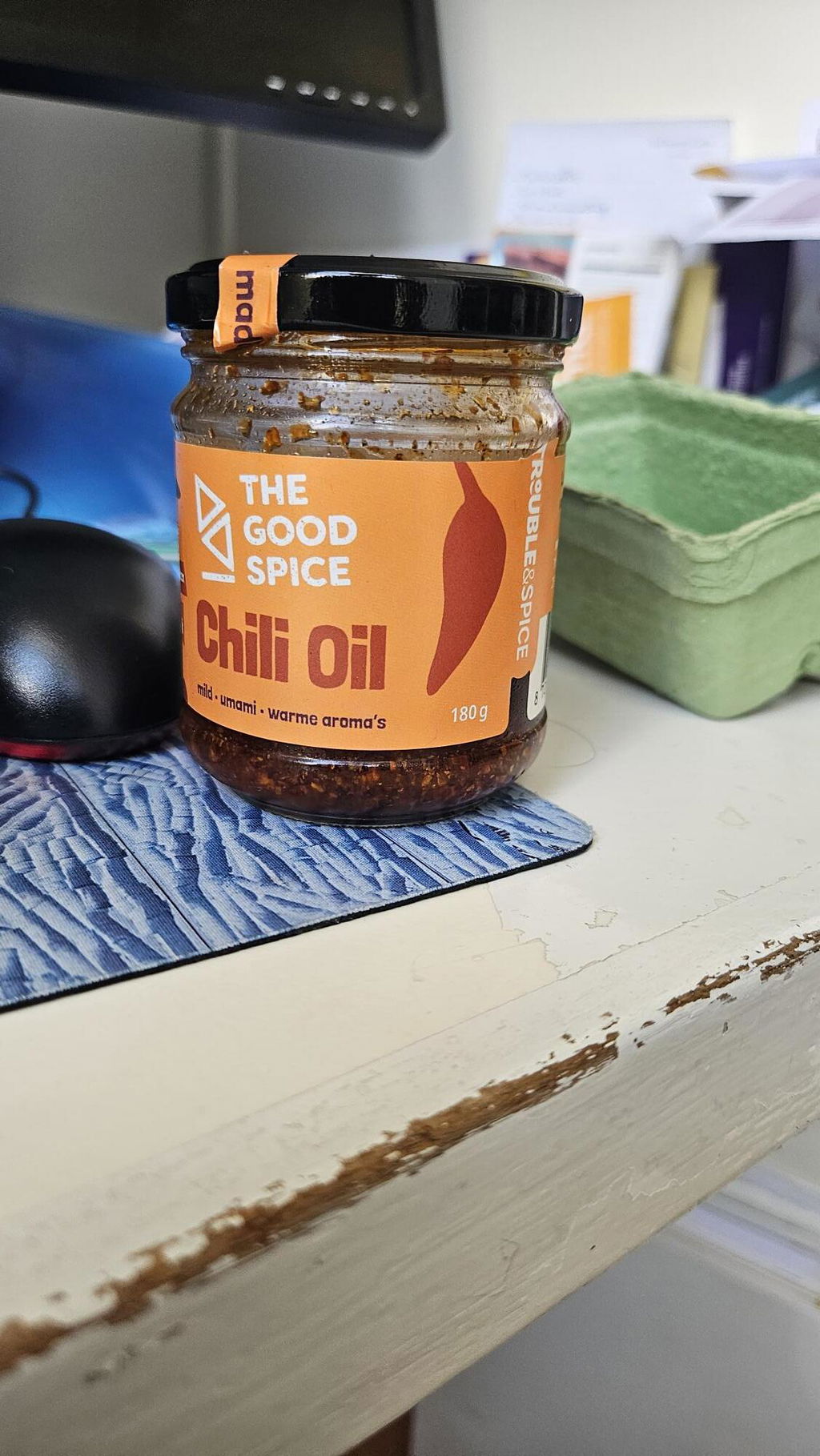
Chilli Oil

€11,95

180 gr

Quantity
Item is in stockOnly 0 left in stockItem is out of stock Item is unavailable
Single Origin
Unsprayed
100% Spice
Short chain

The chili oil is mildly spicy, but also fruity and warm. The other spices (star anise, cloves, and paprika powder) also provide warm, complex aromas. The moromi and shiitake stems provide a deep umami flavour.

This chili oil is actually delicious on everything! From a cheese sandwich to fried eggs. As a dipping sauce for dumplings, in fried rice, over noodles, or even over vanilla ice cream.

This is a quick flavour enhancer. Mix a spoonful into a (dip)sauce, over (grilled) vegetables, or simply as a flavour boost for a toasted sandwich or fried egg. There's little this powerhouse can't handle.

Together with Trouble & Spice, we have developed an ingenious new product (if we do say so ourselves). And thanks to a successful pre-order campaign, we have now been able to produce it!

It has become a true umami bomb. Hatay Chili. Clove. Star Anise. Smoked Paprika Powder.

Trouble & Spice combined this with various no-waste ingredients that also add a lot of complexity, such as shiitake stems and moromi (what's left over during soy sauce production).

Because the Hatay Chili flakes are too fine to become truly crispy, Dutch soybeans and crispy garlic have been added to provide that crunch.

Ingredients: Sunflower oil, chili flakes (The Good Spice), SOY beans (Netherlands, no-waste), onion (no-waste), garlic (Spain, organic), paprika (The Good Spice), star anise (The Good Spice), moromi (WHEAT, SPELT, salt, koji), salt, shiitake (organic, no-waste), clove (The Good Spice)

May contain NUTS and COW'S MILK


Nutrients per 100 grams:

Energy 2985 kJ / 723 kcal

Fat 73 grams
Of which Saturated Fat 8.3 grams
Carbohydrates 9.3 grams
Of which Sugar 2.7 grams
Dietary Fibre 5.0 grams
Protein 5.1 grams
Salt 0.75 grams

Why chili oil?

Setting up a new spice trade is not without its challenges. And that's why we sometimes buy too much of certain spices.

Spices are natural products and can only be harvested once, or at most twice a year. And sometimes we have to look for creative solutions if we have bought too much of a certain harvest.

Farmer Hakan lives in the area that was severely affected by the earthquake in 2023. He had to rebuild his business and chose to grow his spices naturally, without chemicals or pesticides.

This is certainly not the easy way.

And these are exactly the kind of projects that we at The Good Spice like to support, so we placed a large order with him.

Now the new harvest is almost here and we would like to place another order with Hakan, but...

First, we need to process the old harvest.

Fortunately, there's a very tasty way to process chili so it stays fresh for a long time: chili oil!
Chili-SingleOrigin_c41a88ef-adbe-4e6e-bf0f-2d3b30e8fb4a.jpg

How is this chain structured?

All our chains have their own story. Their own piece of land, their own farmer. It is cultivated and processed in a specific way. Join us on a journey into the story behind this taste.

This pul biber is grown by farmer Hakan. He has a small farm in the village of Karsuköyü, in the Hatay region. In February 2023, Karsuköyü was severely affected by the earthquake that occurred there. Many people lost everything, including Hakan.

We came into contact with Hakan through the Karsu Foundation. The Karsu Foundation helps the earthquake victims rebuild their lives.

Unfortunately, sustainable agriculture is not common in the region, but Hakan only wants to farm sustainably. For Hakan, producing healthy products is more important than maximizing production. This applies to both the people who eat the products and the soil itself.

The chili grows from March to September or October depending on the weather.
By the end of October or November, the chili is dried and ground.

Boeren van de Hatay Chili

Let's make an impact!

Every supply chain not only has its own story, but also its own challenges. We would like to share the impact we make per supply chain and how we deal with specific challenges.

Our goal is to buy from Hakan every year, so he is assured of an income in advance and can therefore invest more in the company. And spends less time on a lot of small sales.

By paying Hakan a fair price for the sustainable products, he sets an example in the region that sustainable agriculture, even with lower yields, can be profitable and economically viable.

We do not yet have enough sales to offer Hakan the stability we would like.

In addition, naturally grown chili is very susceptible to pests because it contains a lot of sugar and other substances that many insects love. In Turkey, there are two traditional ways to extend the shelf life of chili. Storing the chilies in the freezer or adding a little salt and olive oil. Since we don't expect Dutch people to quickly adopt the first habit, we have chosen to add a little salt and oil. So, unlike what you are used to from us, something has been added to the spice, with the aim of guaranteeing shelf life and being able to offer a sustainable product.

Frequently asked questions

  • Air, light and moisture are not good for the quality of your spices. Therefore, store them in a tightly sealed jar or tin that is not transparent (or in a dark kitchen cupboard or drawer). Also, do not store them above your stove, as cooking fumes can then get into them. Make sure to always transfer your spices from a repack into a well-sealing jar or tin as quickly as possible.

  • The shelf life of spices is primarily determined by the loss of flavor that occurs over time, as otherwise, they generally don't spoil. We apply a shelf life of 2.5 - 3 years after harvest. This depends partly on the time of packaging and also whether they are whole spices that you have to grind yourself or pre-ground powder.

    Spices in the supermarket have often already been on their way for 2-3 years before they are even packaged and then receive a shelf life of another 3-5 years. Above all, use your senses to judge whether it's still good. At some point, there's simply no flavor left, which is a shame for that beautiful meal!

  • We do not have organic certification, even though our spices meet these standards. All farmers work in harmony with nature and without pesticides, but the certification process is unfortunately very expensive. For small farmers, it's practically unaffordable. And we want to show them that it is worthwhile to grow spices sustainably. That there are people willing to pay for a quality natural product and that they don't first have to make a huge, impossible investment in the form of a certification.

    Some of our farmers do have the certificate, by the way. Corporations, for example, can apply for the certification process jointly, which makes it much more affordable. But to be allowed to put this on the packaging, our entire chain would also have to be certified, including the Social Workshop where the spices are packaged. This is currently not possible because they also work for other non-organic producers. So, in short: no, we are not officially certified, but the quality and way of working are at least as good.

  • Single Origin means that a product comes from one specific place. Often, harvests from different places, sometimes even from different countries and different years, are mixed together. Traders do this to develop the cheapest possible product with a consistent taste. With us, you know exactly where your spices come from, right down to the name of the farmer. This also means that the quality can sometimes vary, as it is a natural product. For example, one year may be drier than another, which can lead to a change in taste. But our farmers always strive for the highest possible taste experience, and you can taste it!

  • We strive to always purchase the latest harvest. Of course, it can sometimes happen that we still have some of an old harvest in stock while the new harvest is already available. So we cannot always guarantee that you will get the very latest harvest, but we do strive for it as much as possible. On the packaging, you will find a QR code to a page where you can find out exactly when your spices were harvested and when they were filled into the tins/pouches. With this, we aim for complete transparency in our process.

  • We ship to most European countries, but this will, of course, involve higher shipping costs. Would you like to order from a country that is not currently an option? Please contact us so we can look into the possibilities.

  • At the Siza Social Workplace, they do their utmost to pack the parcels the day after the order. When it's busy, it might take a day longer. They don't work on Fridays, Saturdays, and Sundays, so if you order on a Thursday, for example, it will take a bit longer before your parcel is shipped.

    Once the parcels are ready, they are picked up by the Groene Rijders and delivered by their bicycle couriers in the areas they serve, or outsourced to PostNL. Depending on how busy they are, they also aim to deliver within 1 working day.

The Taste of Nature

The flavours nature can produce: incredible! We are therefore always looking for the best flavours and the best applications. Quality always comes first.

Packed with love

The filling of the sachets and cans and the packaging of the parcels is done by the Siza Social Workshop. They work on this with great pleasure, but sometimes your order may take an extra day.

Steward-Owned Company

We are Steward-Owned, which means the company serves our mission, and we use profits to invest in the business and in our farmers.